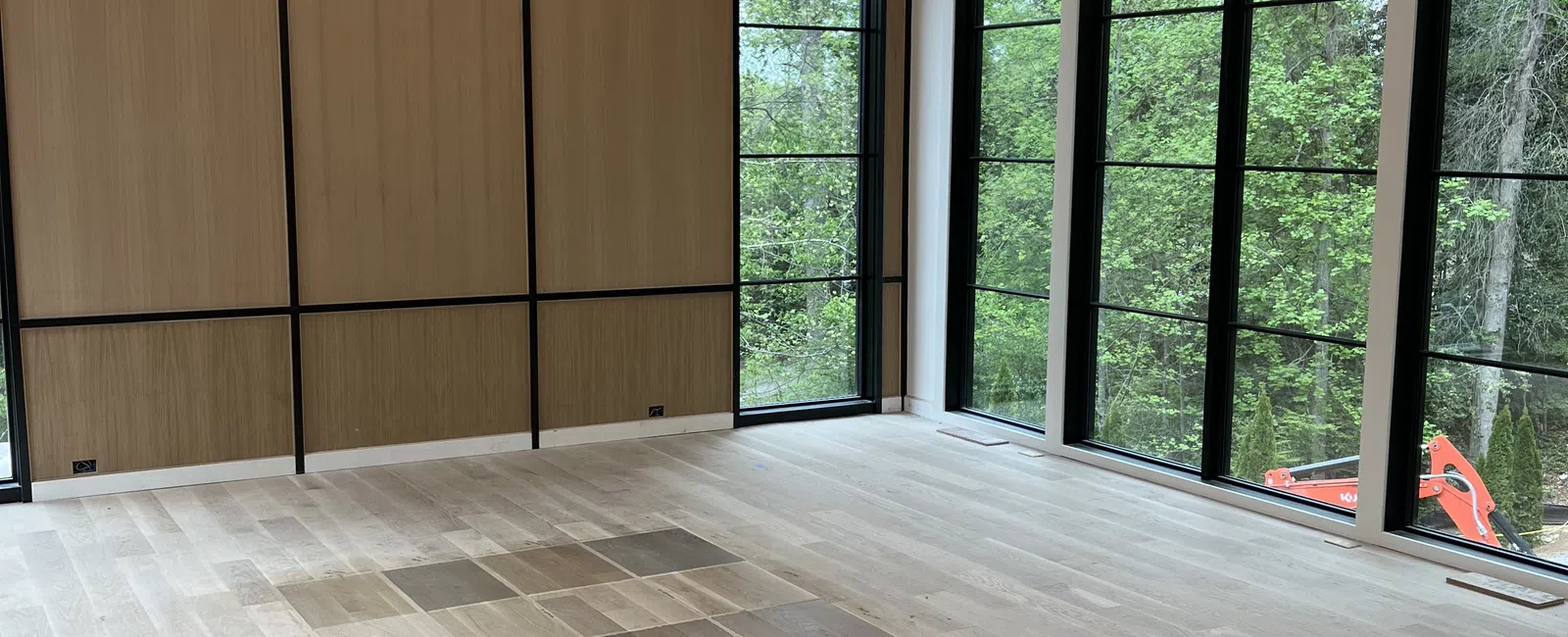
Yes. The floor has to be sanded back to bare wood first, then the new color is applied and sealed. There is no shortcut that works, and the ones sold as shortcuts cause more problems than they solve.
How much work it is depends almost entirely on which direction you are going.
Going Darker Is Straightforward
A darker stain covers what came before, so the existing color matters less. Sand, stain, seal. This is the easiest version of a color change and the most predictable.
The tradeoff is what you are signing up for afterward. Dark floors show dust, footprints, pet hair, and scratches more than any other choice, because a scratch exposes pale wood underneath and the contrast is maximal. Beautiful in photographs, demanding in a house with a dog and two kids.
Going Lighter Is More Work
Lighter means the old color has to come out completely, not be covered up. Stain penetrates into the wood, so sanding has to go deep enough to remove it entirely. That uses more of the floor's finite sanding depth than a color-preserving refinish does.
If the existing floor is very dark, or if the stain has wicked deep along the grain, some residual color can survive the sand. It usually reads as a slight warmth rather than an obvious problem, but it means a truly pale result may need a bleaching step.
Going Grey or Cool Is Its Own Project
This depends entirely on your species, and it is where most disappointment happens.
White oak takes grey and cool tones cleanly, because its underlying tone is brown to olive. Red oak does not. Red oak has a pink to salmon undertone that pushes through, so a grey stain reads mauve or purple-grey rather than true grey.
Getting a true grey on red oak means adding a bleaching or neutralizing step before staining. It works, it costs more, and it takes longer. Any refinisher quoting a grey floor on red oak should be raising this before you sign anything.
Changing Color Without Sanding Does Not Hold Up
The products sold for this are tinted polyurethanes and floor refinishing kits that promise a color change in a weekend. We get called to fix the results.
The problem is that a tinted topcoat sits on the surface rather than penetrating. Every scratch after that reveals the old color underneath, and the color wears off in traffic lanes within a year or two. Worse, the tinted layer complicates any future proper refinish, because it has to come off first.
There is one legitimate version: a tinted or toned recoat applied by a professional to shift a color slightly, usually a warm floor to a slightly cooler one or vice versa. It is a nudge, not a change, and it carries the same wear-through caveat.
The Realistic Sequence
- Test the direction first. Have your refinisher sand a small area and lay down two or three sample colors on your actual floor, since samples on a board will not tell you what your wood does.
- Look at the samples in your own light, at three times of day, next to the cabinets and trim that are staying.
- Sand the room with multiple passes at progressively finer grit.
- Water-pop the wood if going dark, which means wetting it to raise the grain so it accepts stain more evenly and deeply.
- Apply the stain, then seal it, usually with three coats of finish over the stain.
- Cure before furniture goes back. Ask for the specific number of days rather than assuming, since water-based and oil-based finishes differ substantially here.
Two Things to Check Before Committing
- Whether a color change is even the right project. If the floor is only dull rather than the wrong color, a recoat may be all it needs.
- How many sandings the floor has left. Solid hardwood generally allows four to six over its life, and each color change uses one, with going lighter often using more depth than a straight refinish. Engineered flooring is limited by its wear layer: none under 2mm, usually one at 3mm, and two or three at 4 to 6mm. Ask before planning a color change on engineered flooring.
- Whether the color change affects stairs and adjoining rooms. Stairs are priced separately, and matching a new floor color to existing stair treads is often the harder part of the job. So is stopping the new color at a threshold where the old color continues.
Sampling Before You Commit to a Color
Sampling on your own floor is the only way to know what your wood will do with a given stain, and it costs almost nothing to find out. TriArt Hardwoods refinishes hardwood across Atlanta, Johns Creek, and Sandy Springs. See our refinishing service or get in touch.