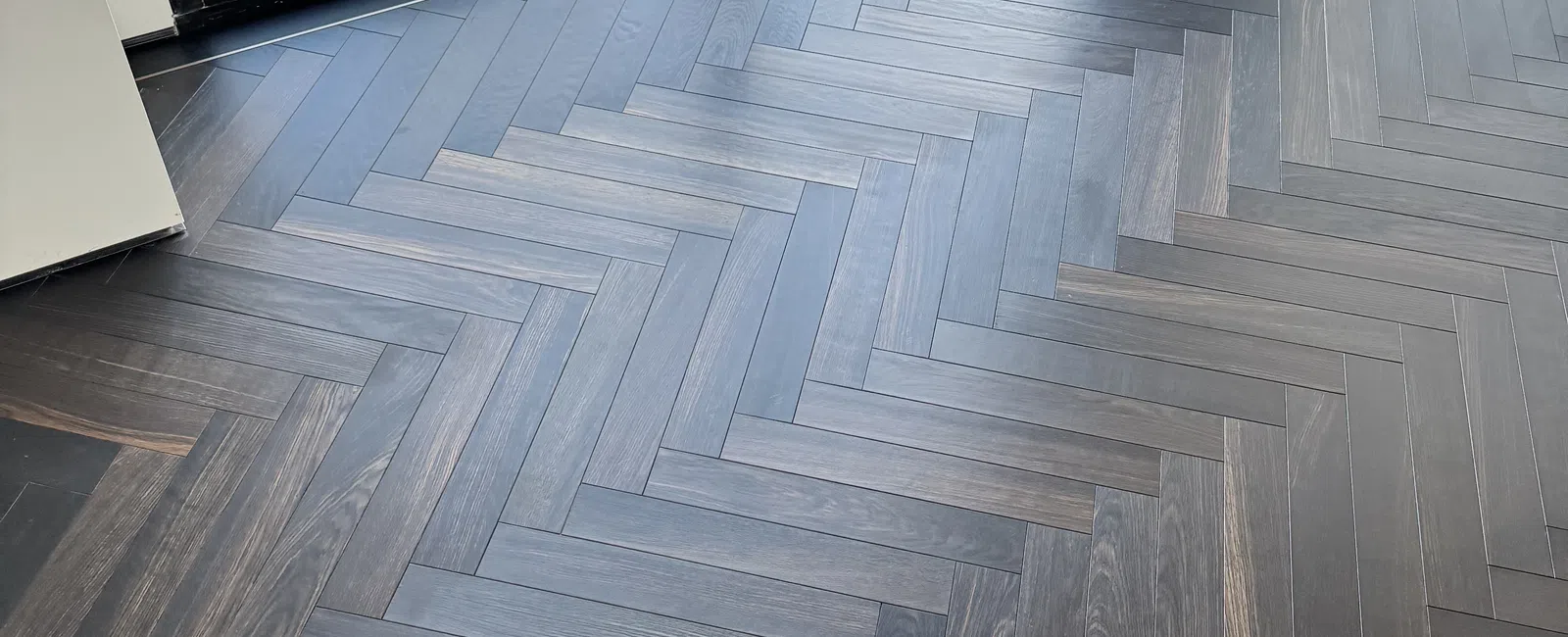
Pattern is the one flooring decision that changes a room more than the wood does. Same oak, same stain, laid three different ways, reads as three different houses.
It is also the decision with the widest cost range. Straight-lay is the baseline. Some patterns double the installation labor and add ten percent or more to the material waste. Here is what each one does and what it costs you to get it.
Straight Lay
Boards running parallel to each other in one direction, with end joints staggered. The default, and the right answer in most houses.
Convention is to run boards along the longest dimension of the room, which makes the space read as longer, and perpendicular to the floor joists, which is a structural requirement for most nail-down installations. When those two rules conflict, the joists win unless a plywood underlayment is added.
Straight lay also makes future repairs easiest, which matters more than people expect, since replacing a single damaged board means matching a straight run rather than working around angled or interlocking joints.
Cost: baseline. Waste: 7 to 10 percent.
Diagonal
The same straight lay rotated 45 degrees to the walls. It makes a room feel wider, draws the eye to the corners, and disguises walls that are not square, which is genuinely useful in older houses.
The tradeoff is waste. Every board meeting a wall is an angled cut, so offcuts pile up fast.
Cost: modest labor increase. Waste: 15 to 20 percent.
Chevron
Boards cut at an angle at both ends and joined point to point, so the pattern forms continuous unbroken V shapes running down the room. The cuts mean the boards meet in a clean line rather than overlapping.
Chevron is the more formal and more modern of the angled patterns. It demands precision, because every angle is cut and any error accumulates visibly across a room. Most chevron is bought as a prefabricated product with the angles milled at the factory, which is the sensible way to do it.
Cost: substantially higher labor. Waste: 15 percent or more, less if prefabricated.
Staggered Zigzag Boards
Rectangular boards laid at right angles to each other in a staggered, interlocking zigzag pattern, commonly known as herringbone. The ends are square rather than angled, which is what distinguishes it from chevron: in this pattern the boards overlap at the joint, while in chevron they meet point to point.
Older, warmer, and more forgiving than chevron because the rectangular boards do not need angled cuts. Still one of the slowest patterns to install, because every board has to be set against a working line and errors compound.
We laid a bog oak version of this pattern in Midtown that shows what it does at scale in a real room, which is more useful than a sample. See the Midtown herringbone project.
Cost: can approach double straight-lay labor. Waste: 10 to 15 percent.
Parquet
Geometric tiles of small wood pieces arranged into repeating blocks. Versailles, Chantilly, basketweave and similar named patterns fall in this family. Usually supplied as prefabricated panels rather than assembled on site.
Historically accurate in period homes and distinctly formal in contemporary ones. A full room of parquet is a statement. A parquet panel set as a feature inside a straight-lay field, in an entryway or under a dining table, is a common and cheaper compromise.
Cost: high, and varies enormously by pattern. Waste: low when using panels.
Random Width
Mixed board widths, typically three sizes, laid straight with the widths distributed so no pattern emerges. Reads as older and less manufactured than uniform-width flooring, which suits farmhouse, colonial, and rustic interiors.
It needs planning. Left to chance the widths clump and the floor looks accidental rather than intentional. A good installer lays out the sequence before fastening anything.
Cost: slight labor increase for layout planning. Waste: 10 percent.
Borders and Inlays
A contrasting band running around the perimeter of a room, sometimes with a mitered corner detail or a feature strip. Common in early twentieth century houses and worth reproducing if you are restoring one.
Borders define a room within an open plan, which is their most useful modern application. They also complicate any future refinish, because the border and field may sand differently.
Cost: priced per linear foot on top of the field. Waste: minimal.
Choosing a Pattern
| If you want | Consider |
|---|---|
| Maximum floor for the budget | Straight lay |
| A narrow room to feel wider | Diagonal, or straight lay across the width |
| A formal, contemporary statement | Chevron |
| A traditional, textured statement | Herringbone |
| Period accuracy in an older home | Parquet or a border |
| A relaxed, aged look | Random width |
| Zones inside an open plan | A border, or a change of direction at a threshold |
Practical Points to Plan Around
- Patterns need flatter subfloors. Angled and interlocking patterns telegraph subfloor problems more than straight lay does, because the eye follows the lines. Budget for subfloor prep, not just pattern labor.
- Order the waste factor the pattern needs, and order it all at once. Dye lots vary between production runs and a mid-job reorder can arrive visibly different.
- Patterns are harder to repair. Replacing a damaged board in a herringbone or chevron field is far more involved than in straight lay, which is where a hardwood floor repair visit typically starts. Keeping spare material from the original order makes that job considerably easier.
Mixing Patterns Works Best at a Threshold
Combining patterns in one house is common and it works, but it holds up best when the change happens at a clear threshold rather than in the middle of an open space. A patterned entryway opening into a straight-lay living area is a common and successful approach, because the doorway itself reads as the reason for the change. Switching patterns mid-room without a border or a threshold to justify it usually reads as a mistake rather than a choice, even when both patterns are well executed on their own.
Seeing These Patterns in Your Own Space
Pattern decisions are easier with a floor in front of you than a sample in your hand. TriArt Hardwoods installs straight lay, diagonal, herringbone, chevron, and custom pattern work across Atlanta, Johns Creek, and Sandy Springs. Our hardwood floor installation page has more on the process, or our contact page can get a pattern conversation started.