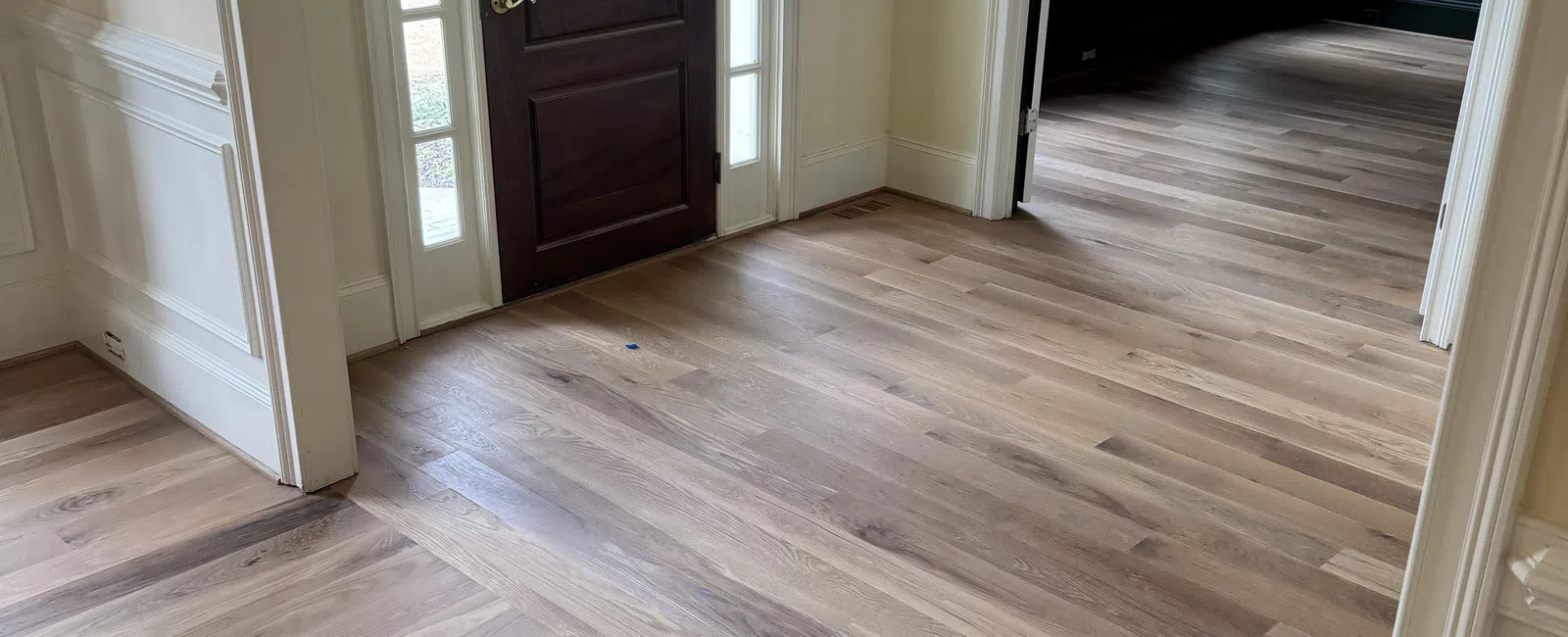
The framing most people arrive with is that solid hardwood is the real thing and engineered is the compromise. That was defensible twenty years ago. It is not a useful way to decide today.
Both are real wood on the surface. The difference is what sits underneath, and that difference determines where each one can go, how long it lasts, and how many times it can be refinished. Pick based on your subfloor and your humidity, not on which one sounds better.
What Each One Actually Is
Solid hardwood is a single piece of wood, typically three quarters of an inch thick, milled with a tongue and groove. It is the same species all the way through.
Engineered hardwood is a real hardwood veneer bonded to a plywood or HDF core, with the core plies cross-laminated so the grain runs in alternating directions. That cross-lamination is the entire point: it makes the board far more dimensionally stable when humidity changes.
The number that matters most on engineered flooring is the wear layer thickness, meaning how much real hardwood sits above the core. Under 2mm and the floor cannot ever be sanded. At 3mm you get one careful refinish. At 4 to 6mm you get two or three, which puts a premium engineered floor in the same practical lifespan bracket as solid.
This single number separates the engineered flooring worth buying from the engineered flooring that gives the category a bad name, and it is the first thing to ask about any product you are considering.
The Comparison
| Solid hardwood | Engineered hardwood | |
|---|---|---|
| Refinishes | Many times. Often 4 to 6 over a lifetime. | Depends entirely on wear layer. Zero to three. |
| Over concrete slab | Not directly. Needs a plywood subfloor built over it. | Yes, glued or floated with a moisture barrier. |
| Below grade (basements) | No | Yes, with proper moisture control |
| Humidity swings | Expands and contracts noticeably. Seasonal gapping is normal. | Far more stable. Less seasonal movement. |
| Wide planks | More prone to cupping and gapping at width | Handles wide planks better |
| Radiant heat | Generally not recommended | Usually approved, check the manufacturer |
| Installation methods | Nail or staple down, to wood subfloor | Nail, glue, or float |
| Cost | Wide range by species | Wide range by wear layer. Quality engineered is not cheap. |
| Resale perception | Still carries a slight edge with some buyers | Gap has narrowed considerably. Quality matters more than category. |
How to Decide, in Order
1. Subfloor Comes First
This eliminates one option in a lot of houses before anything else is considered.
Concrete slab, or a basement, or any space below grade: engineered. Solid hardwood over a slab requires building a plywood subfloor on top of it, which costs money and raises the floor height enough to create door and transition problems.
Plywood or OSB subfloor on a raised foundation: either works.
2. Humidity Stability Comes Next
Georgia summers are humid and heated winters are dry. That swing is real, and solid hardwood responds to it by expanding and contracting. In a house with good climate control it is a non-issue and shows up only as minor seasonal gapping that closes in summer. In a house that sits empty and unconditioned for stretches, or a vacation property, or a room over an unconditioned crawl space, it is a bigger deal and engineered handles it better.
3. How Long You Are Staying Matters
If this is a forever house, solid hardwood or engineered with a 4mm-plus wear layer are the options worth considering, because both can be refinished multiple times and taken through several changes of taste. A refinish, whether on solid or thick-wear-layer engineered, can change the stain color and sheen substantially without replacing the floor.
If you plan to sell within five to seven years, the refinishing question is largely academic and the decision comes down to appearance and budget.
4. Board Width Affects the Decision
Wide plank is the current preference in most of the homes we work in, and wide solid boards move more than narrow ones. A seven-inch solid plank in a house with swinging humidity will gap and cup more visibly than a three-inch one. Engineered is the safer choice at width.
5. The Room Narrows the Choice
Kitchens and any room where liquid is regularly on the floor: neither is waterproof, and both need spills addressed promptly. Engineered tolerates humidity better, but a standing spill damages both.
Bathrooms and laundry rooms: we generally steer people away from wood entirely and toward luxury vinyl plank or tile. A waterproof product in a wet room is not a compromise, it is the right material. See our Bathroom Remodeling services for more options.
What We See Going Wrong
The failures we get called to look at follow a short list:
- Cheap engineered with a 2mm wear layer, worn through in traffic lanes after eight years. There is nothing to sand. The only fix is replacement. This is the single most common engineered flooring regret.
- Solid hardwood installed over a slab without a properly built subfloor, which cups within the first humid season.
- Solid hardwood installed without acclimation, which gaps badly the first winter because the wood came in wet and dried in place.
- Floating engineered installed with no expansion gap at the walls, which buckles when the floor grows and has nowhere to go.
Three of those four are installation failures rather than material failures, which is why the installer matters nearly as much as the product itself.
Where Engineered Hardwood Falls Short
The wear layer is the real limitation: under it, the floor cannot be refinished at all, and even a good wear layer tops out around two or three sandings against solid hardwood's four to six. Quality also varies far more within the engineered category than it does within solid, which makes it easier to buy badly. A thin-wear-layer product from a discount retailer and a thick-wear-layer product from a reputable mill both get sold as "engineered hardwood," and only one of them is a floor worth installing.
Getting a Recommendation for Your House
Bring us your subfloor situation and your timeline and we will tell you which one we would put in our own house. TriArt Hardwoods installs both across Atlanta, Johns Creek, and Sandy Springs. Our hardwood floor installation team can walk your space, or our contact page can get that started.