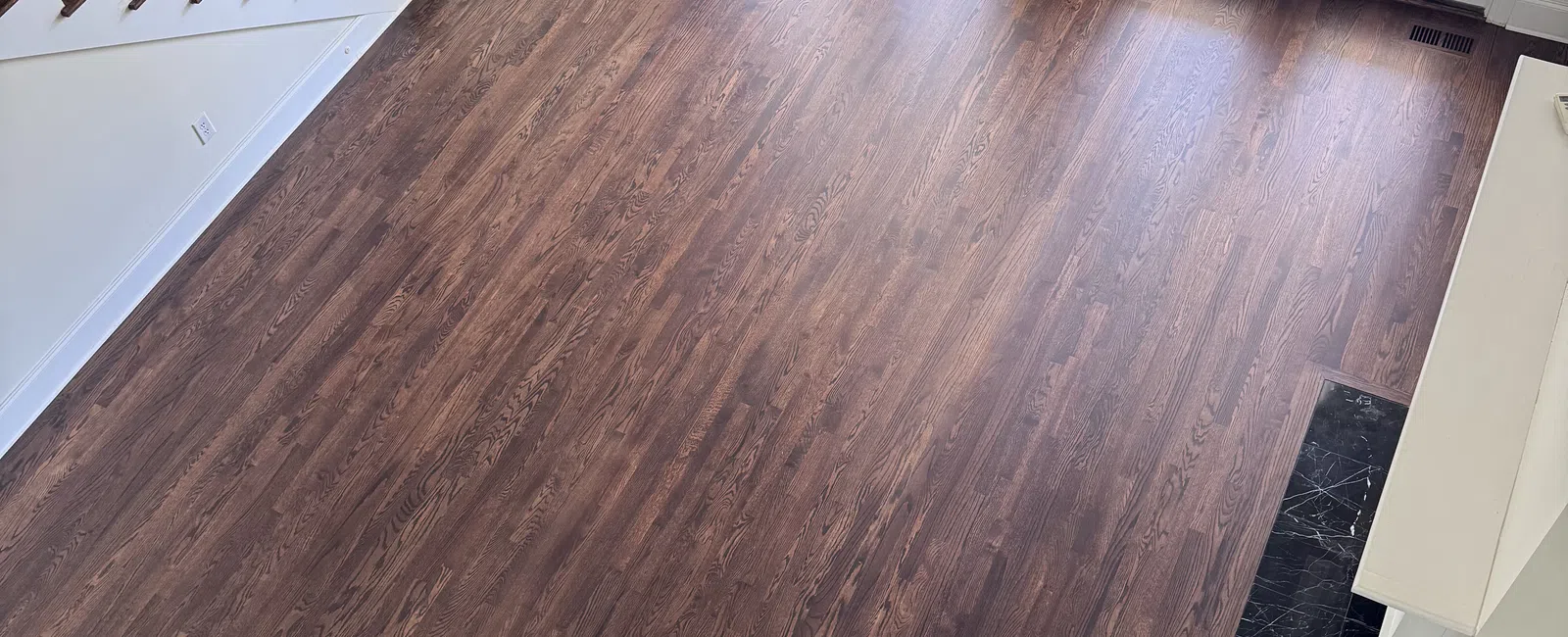
Most homeowners installing hardwood land somewhere between $8 and $18 per square foot installed, materials and labor together. That is a wide range because it is answering a wide question. A prefinished engineered floor going down over a clean, flat subfloor sits near the bottom. Site-finished white oak in a herringbone pattern over a floor that needs leveling sits near the top.
What follows is what actually moves that number, so you can read a quote and understand why it says what it says.
The Two Halves of a Quote
Materials
Typically $3 to $14 per square foot. The spread comes from:
- Species. Red oak is the baseline and the most affordable. White oak runs meaningfully higher. Walnut, hickory, and exotics higher still.
- Grade. Select grade, with minimal knots and consistent color, costs more than common grade. Neither is better wood structurally, since it is an appearance sort rather than a strength one.
- Board width. Wide plank costs more per square foot than strip flooring, both in material and in labor, because wide boards need more careful acclimation and fastening.
- Solid or engineered. Comparable quality engineered often costs similar to solid. Cheap engineered is much cheaper and has a thin wear layer that cannot be refinished.
- Prefinished or unfinished. Prefinished costs more per board but skips the sanding and finishing labor. Unfinished costs less per board and adds several days of on-site work.
Labor
Typically $4 to $8 per square foot for installation alone, and higher when site finishing is included. Labor is where quotes diverge most, and almost always for reasons visible in the house rather than in the flooring.
What Pushes Labor Up
| Factor | Effect on cost | Why |
|---|---|---|
| Subfloor needs leveling | Significant add | Hardwood telegraphs every dip. Flattening is not optional and is often not visible until the old flooring comes up. |
| Existing flooring removal | Moderate add | Carpet and pad come up easily. Glued vinyl, tile, and multiple layers do not. |
| Concrete slab instead of plywood | Moderate add | Requires a moisture barrier and usually rules out nail-down, pushing you toward glue or float. |
| Pattern work | Large add | Herringbone and chevron can double installation labor. |
| Many small rooms and closets | Moderate add | Cuts, transitions, and thresholds are slow. Open floor plans install faster per square foot. |
| Stairs | Priced separately | Stairs are quoted per step, not per square foot. See our stairs and tread service. |
| Site finishing | Large add | Sanding, staining, and three coats of finish is several days of skilled work plus cure time. |
| Furniture and appliance moving | Small add | Some contractors include it, some do not. Worth asking directly. |
Worked Examples
Using a mid-range installed figure of roughly $12 per square foot, which assumes decent quality oak, a sound subfloor, and no pattern work:
A 12 by 12 room, 144 square feet
Roughly $1,400 to $2,200 installed. Small rooms carry a penalty per square foot, because setup, delivery, and minimum charges are spread across a small area. Some contractors have a job minimum that a single room will not clear.
A 500 square foot area, typical for a main living space
Roughly $4,500 to $8,500 installed. This is the size where per-square-foot pricing starts behaving normally.
1,000 square feet, typical for a main floor
Roughly $8,000 to $18,000 installed. At this size the variables matter most. The same 1,000 square feet can come in near $8,000 with prefinished engineered over a clean subfloor, or near $18,000 with site-finished wide plank white oak over a slab that needs prep.
If you are comparing quotes at this size and they are far apart, the difference is almost never the crew's hourly rate. It is scope. One quote includes subfloor leveling and the other assumes the subfloor is fine.
2,000 square feet, whole main floor plus hallways
Roughly $16,000 to $36,000. Larger jobs often see a modest per-square-foot improvement because mobilization costs are spread further, but material cost scales linearly and dominates at this size.
Costs That Surprise People
Subfloor repair is the big one, and it catches almost everyone off guard because nobody actually knows what condition the subfloor is in until the old flooring comes up. A contractor who has seen enough houses will flag it as a possible change order up front rather than let you assume the first number is final. Floor height moves too, since new hardwood rarely sits at the exact same thickness as whatever it replaces. That means shoe molding almost always needs replacing, baseboards sometimes do, and interior doors often need to be trimmed at the bottom before they clear the new floor. Every doorway between rooms with different flooring needs its own transition piece as well, and those are priced individually rather than folded into the per-square-foot rate.
A few of the other surprises are about time rather than money. Wood has to acclimate in the house for several days before installation can even start, which does not add to the bill but does push the schedule further out than people expect. Disposal of the old carpet, tile, or vinyl is sometimes bundled into the quote and sometimes billed separately, so it is worth confirming rather than assuming either way. And the material figure itself should already carry a waste allowance, typically 7 to 10 percent for a straightforward layout and more for anything with a pattern. A quote that lines up exactly with your square footage, with nothing added for cuts, is quietly underestimating what the job will take.
Removing Carpet First
Replacing carpet with hardwood is the most common version of this project, and it adds removal, disposal, and often tack strip and staple cleanup to the job. It is usually a smaller add than people expect.
What DIY Actually Saves
On paper, you save the labor half of the quote. In practice, three things eat into that before the project is done. Tool rental is the first: a flooring nailer, compressor, miter saw, table saw, and jamb saw add up fast, and renting all of it for a week takes a real bite out of the savings. Subfloor prep is the second, and the more important one, since it determines whether the floor stays flat and quiet for the next twenty years, and it is also the part of the job with the least room for learning as you go. Waste is the third. Experienced installers work at 7 to 10 percent waste on a typical layout, while first-timers often run 15 percent or more, which is real money once you are buying premium material.
Engineered click-lock over a flat subfloor is a reasonable DIY project. Nail-down solid over a subfloor that needs work, or anything site-finished, is not, and mistakes made during subfloor prep are the ones that show up years later as squeaks or cupping.
How to Compare Quotes Properly
Ask every contractor the same questions and the quotes become comparable:
- Does this include removing and disposing of the existing flooring?
- What is assumed about the subfloor, and what happens if it needs leveling?
- Is the waste factor included in the material figure?
- Are shoe molding, transitions, and door trimming included?
- Is this prefinished or site-finished, and how many coats of finish?
- How many days will the house be unusable, and what is the cure time before furniture goes back?
- What warranty covers the installation itself, separate from the manufacturer's warranty on the wood?
A quote that is meaningfully lower than the others is usually excluding something the others included. Find out what before deciding it is a better deal.
Hardwood Holds Its Value Well
New hardwood is consistently one of the better-returning interior renovations in resale surveys, and it is frequently cited by buyers as a preference over carpet. The return varies by market and by what the rest of the house looks like, so it is worth treating as a project that holds its value well rather than one that is guaranteed to pay for itself outright.
Getting a Number for Your Actual House
Square footage is the easy part. The subfloor, the layout, and the finish decision are what set the real number, and those need someone to look. TriArt Hardwoods installs hardwood across Johns Creek, Sandy Springs, and Atlanta. See our hardwood floor installation service or get in touch for a quote.